
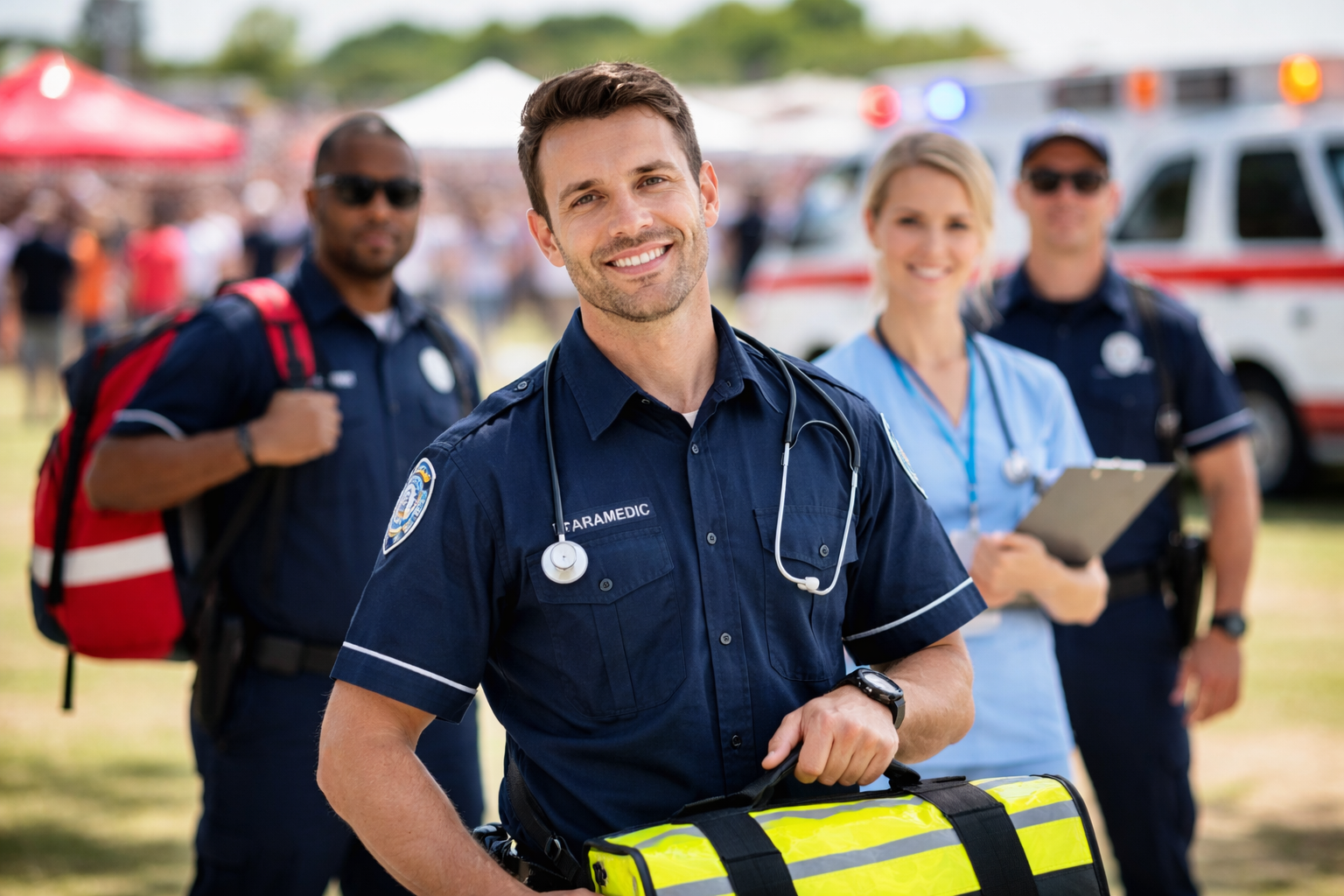
Whether you’re organizing a music festival, a corporate retreat, a charity race, or a youth sporting competition, one question always comes up: what kind of medical coverage does your event actually need? Event First Aid services covers on-site first aid staffing, and not every provider is the same. Understanding what event First Aid services include, what they don’t cover, and how to find the right fit for your event can mean the difference between a well-run event and a stressful one.
This guide breaks down exactly what event First Aid services are, what they typically include, and how to evaluate your options.
1. What Are Event First Aid Services?
Event First Aid services refers to professional on-site First Aid staffing designed specifically for events and gatherings. Unlike emergency medical services (EMS), which are dispatched in response to 911 calls, event First Aid services are deployed to your venue to respond to incidents as they arise, and coordinate with local emergency services if the situation escalates.
A qualified event First Aid provider supplies trained First Aid Responders — credentialed EMTs, Paramedics, or Registered Nurses operating under physician-delegated authority — who are positioned on-site throughout your event to respond to incidents as they arise.
2. What Does Event First Aid Services Include?
The scope of event First Aid services can vary by provider, but a comprehensive provider should offer the following.
Guest Monitoring and Scene Survey
Trained First Aid Responders conduct scene surveys and assess guests who present with signs of medical distress, capturing vital signs when indicated and responding to incidents as they arise.
First Aid and Emergency Response
This includes CPR, AED administration, first aid for bleeding and wound care, first aid for chest pain, first aid for stroke, first aid for opioid overdose, first aid for tick and snake bites, first aid for seizure, splinting and ambulatory assistance. A well-equipped First Aid team arrives with the supplies and training to respond to these situations on-site.
Physician-Directed Oversight
The strongest providers operate under the remote supervision of a licensed physician. This means your on-site team isn’t administering first aid in isolation; they’re working within physician-directed guidelines and can consult with the Physician Medical Director in real time when needed.
Escalation and Continuity of Care
When a situation exceeds first aid scope, a professional First Aid team activates 911, coordinates with the arriving ambulance crew, and maintains HIPAA-compliant documentation of every encounter.
3. What Event First Aid Services Are Not
It’s important to understand the limitations of first aid and BLS (Basic Life Support) event First Aid staffing. These providers typically are not:
- Licensed EMS providers — they do not operate ambulances or provide patient transport
- A replacement for EMS coverage, which may be required by local regulation
- Advanced Life Support (ALS) providers
If your event or venue requires a licensed ambulance standby under local law, you will need to arrange that separately. A reputable event First Aid provider will be upfront about this distinction rather than overstating their scope.
4. Who Needs Event First Aid Services?
The short answer: almost any organized gathering benefits from having trained First Aid Responders on-site. Common events that rely on professional event First Aid services include concerts and music festivals, corporate events and conferences, youth and professional sports, TV and film productions, weddings and private parties, and experiential marketing activations.
Events involving physical activity, large crowds, outdoor environments, or vulnerable populations have the highest need for dedicated on-site First Aid support.
5. How to Evaluate an Event First Aid Services Provider
When comparing providers, here are the key questions to ask:
- Are your staff licensed or certified EMTs, Paramedics, or Registered Nurses?
- Are background checks completed for all personnel?
- Do your responders operate under physician delegated authority?
- What is your escalation protocol when a situation exceeds first aid scope?
- Do you maintain HIPAA-compliant documentation for every encounter?
- What is your minimum shift requirement?
- Do you offer national coverage or are you local only?
A provider that can answer these questions clearly — and is transparent about what they don’t provide — is a partner you can trust.
6. Why Physician Oversight Is a Critical Differentiator
Not all event First Aid staffing providers operate under physician-directed guidelines. Those that do provide a significant advantage: your on-site team works within physician-directed guidelines, has access to real-time consultation with the Physician Medical Director, and can make more informed escalation decisions in the field. This matters most in complex situations like suspected overdoses, cardiac events, and traumatic injuries.
7. Conclusion
Event First Aid services are an important component of event planning. Whether your event is small and private or large and public-facing, having trained, credentialed First Aid Responders on-site supports structured response and allows you and your team to focus on delivering a great experience.
Heed Health provides professional on-site first aid and emergency response support for events of all sizes, backed by physician oversight and staffed by verified EMTs, Paramedics, and Nurses. Ready to discuss coverage for your next event? Request a quote from Heed Health today.