
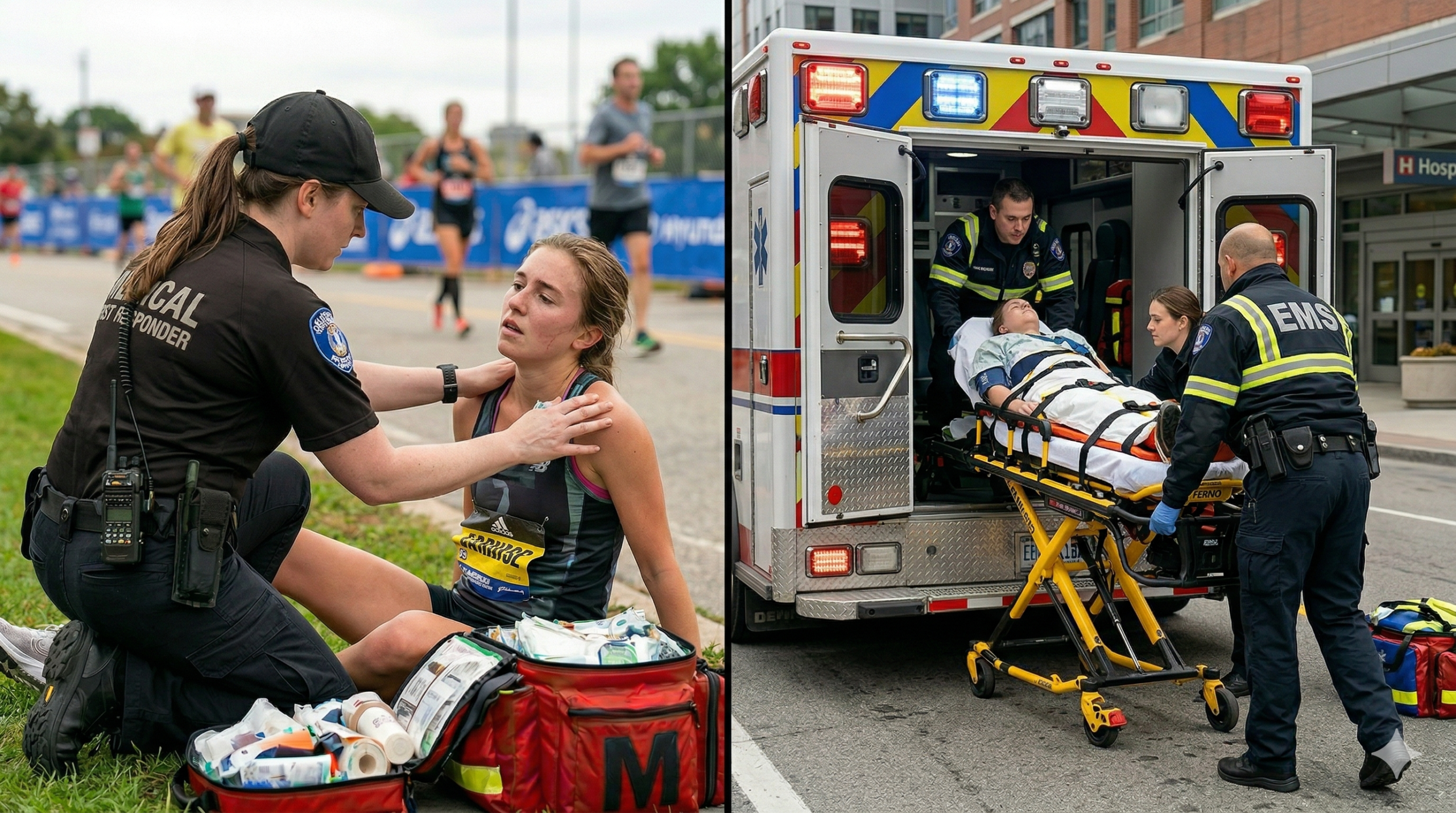
1. Event First Aid vs. EMS: What’s the Difference?
When planning First Aid coverage for an event, many organizers assume they need to hire an ambulance or full EMS crew — when in reality, what most events actually need is professional on-site first aid staffing. But the distinction between event first aid and EMS can be confusing, and getting it wrong could mean either overpaying for services you don’t need or underpreparing for your event’s actual activity profile.
This article breaks down the difference between event first aid and EMS, explains when each is appropriate, and helps you understand what a physician-directed first aid team can and cannot do.
2. What Is Event First Aid?
Event first aid refers to on-site First Aid staffing provided by credentialed First Aid Responders — EMTs, Paramedics, or Registered Nurses operating under physician-delegated authority — whose primary role is to respond to incidents, and escalate care to EMS or emergency departments when needed.
A professional event first aid team operates within physician-directed guidelines under the remote oversight of the Physician Medical Director. They carry supplies for wound care, CPR, AED use, bleeding control, and more — and they’re positioned to respond when something happens at your event.
3. What Is EMS?
EMS (Emergency Medical Services) refers to the system of licensed emergency responders — including EMTs and Paramedics operating under state licensure — who respond to 911 calls and provide emergency transport. EMS providers operate ambulances, deliver Advanced Life Support (ALS), and transport patients to hospital emergency departments.
Key characteristics of EMS include: dispatched via 911 or direct deployment, licensed under state EMS regulations, capable of patient transport, and able to provide ALS services including IV medications and advanced airway management.
4. Key Differences Between Event First Aid and EMS
Event first aid focuses on on-site response, response, and escalation. EMS focuses on emergency transport and advanced life support. Event first aid cannot transport patients — they activate 911 when transport is needed. EMS can respond to and transport patients to hospitals. Event first aid is deployed at your event; EMS is dispatched reactively via 911. Event first aid is significantly more cost-effective than standby ambulance services.
5. When Do You Need EMS vs. Event First Aid?
Not all events require a standby ambulance — but local regulations and event type matter significantly.
Event first aid is typically sufficient for corporate conferences and private gatherings, concerts and festivals with good venue access for 911 response, youth sports and recreational events, experiential activations and brand events, and smaller outdoor gatherings.
You may also need licensed EMS in situations such as events in remote or rural locations where 911 response times are long, high-attendance outdoor festivals where local regulations require ALS coverage, motorsports or extreme sports events with elevated injury risk, and events in jurisdictions that legally mandate ambulance standby.
A reputable event first aid provider will be transparent about these distinctions and encourage you to consult local regulations.
6. The Role of Physician Oversight in Event First Aid
One of the most important differentiators in event first aid is whether your provider operates under physician-directed response guidelines. When a first aid team has a Physician Medical Director, the on-site responders can consult with the physician remotely for guidance, follow physician-directed guidelines for complex situations, and make better-informed escalation decisions in the field.
This doesn’t make them EMS — but it makes them significantly more capable than a first aid station with no physician backing.
7. The Cost Consideration
Standby ambulance and ALS coverage can be expensive — and for many events, it’s more than you actually need. Physician-directed first aid staffing provides professional, physician-supervised coverage at a fraction of the cost, making it the right-fit choice for the vast majority of corporate events, festivals, sporting competitions, and private gatherings.
8. The Bottom Line for Event Organizers
Most events need dedicated, professional on-site first aid coverage — but not necessarily a standby ambulance. Understanding the difference allows you to make smarter, more cost-effective decisions. The goal is to ensure that when something happens, trained personnel are already present, equipped, and working within a physician-directed framework prepared to respond.
9. Conclusion
Event first aid and EMS serve different but complementary roles. For most events, professional first aid staffing backed by physician oversight provides on-site coverage, encounters documented, and escalations handled appropriately.
Heed Health provides exactly that — licensed EMTs, Paramedics, and Nurses operating in a first aid capacity under physician-directed guidelines, available for events of all types and sizes across more than 25 states. Contact Heed Health to discuss coverage for your next event.