
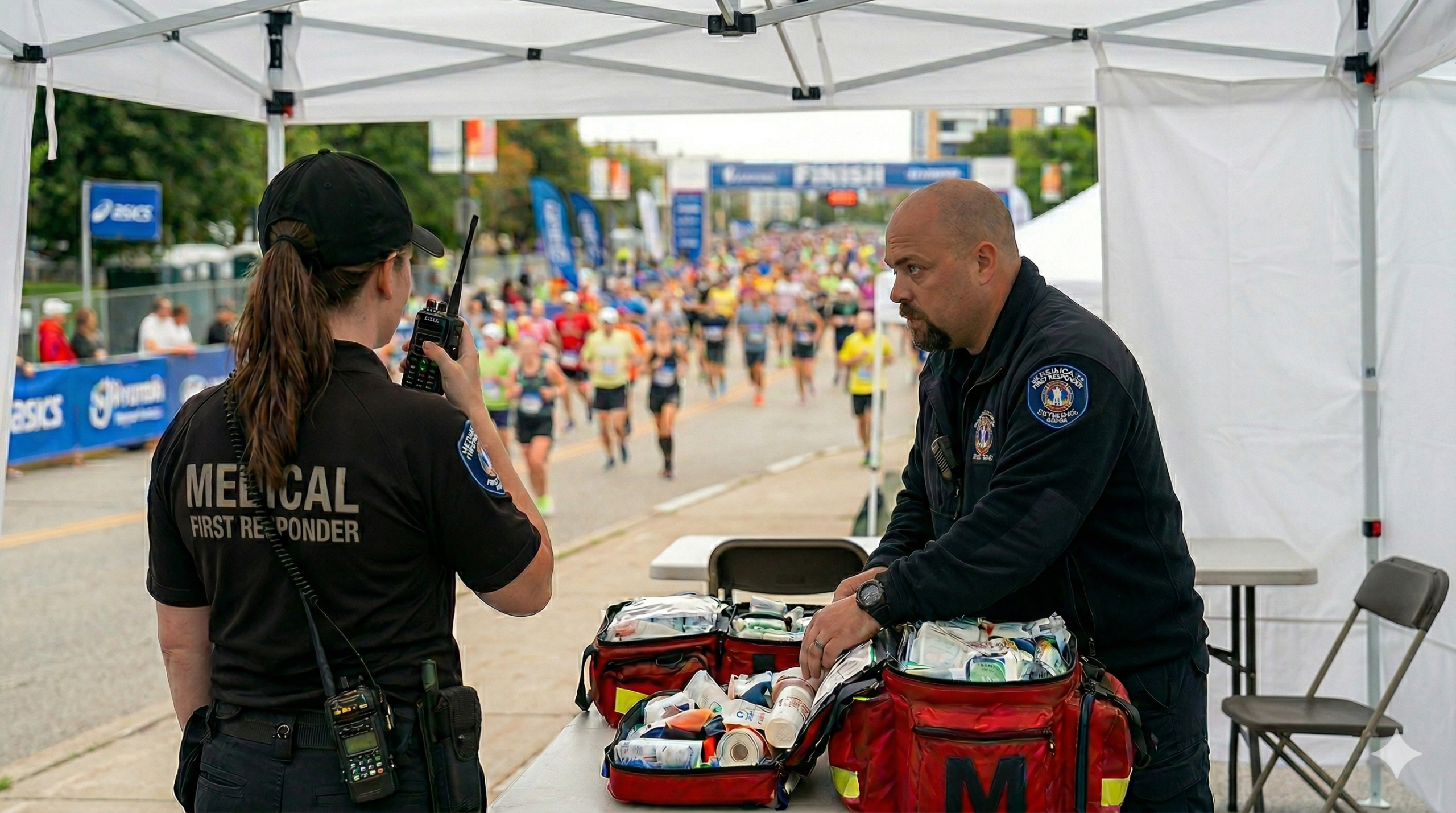
When researching event First Aid providers, you’ll often encounter the phrase “physician-directed” – but what does it actually mean, and why should it matter to you as an event organizer? Not all event First Aid teams are created equal. The presence of physician oversight fundamentally changes the capability and credibility of your on-site First Aid coverage.
This article explains what physician-directed event First Aid coverage means, how it works in practice, and why it’s one of the most important factors to look for when evaluating a provider.
1. What Does Physician-Directed Mean?
Physician-directed event First Aid coverage means that the on-site First Aid team — credentialed EMTs, Paramedics, or Registered Nurses — operates under the remote oversight and physician-delegated authority of a licensed physician.
In this model, the Physician Medical Director provides physician-directed guidelines that govern how the on-site team responds to specific situations, availability for remote consultation via phone or video during the event, and the delegated authority that defines the scope of care provided by the on-site team.
This is distinct from a first aid team that operates without any physician connection — one that functions without formal physician oversight and has limited ability to escalate decisions appropriately.
2. How Physician Oversight Works in Practice
During your event, a physician-directed First Aid team operates as follows. On-site responders conduct scene surveys and respond to incidents as they occur. For routine first aid situations — wound care, exhaustion, minor injuries — the team follows established physician-directed guidelines. For complex presentations such as suspected cardiac events, overdoses, traumatic brain injuries, the on-site team consults with the Physician Medical Director by phone or video in real time. The Physician Medical Director can provide guidance and recommend escalation to 911 where needed.
This creates a structured connection between your on-site team and licensed emergency medicine expertise — without requiring a physician to be physically present at your event.
3. What a Medical Director Should Look Like
The quality of physician oversight varies. The gold standard is a board-certified emergency medicine physician — a specialist trained specifically in the acute presentations most likely to occur at live events. A board-certified emergency medicine physician brings the highest level of relevant expertise to the oversight role, and the guidelines your on-site team follows are developed and supervised by a specialist in acute and emergency care.
4. Why Physician Direction Matters for Complex Situations
Several common event scenarios illustrate why physician direction makes a meaningful difference in response quality.
Suspected Opioid Overdose
Recognizing and responding to an overdose — including appropriate use of reversal agents — requires trained judgment within a defined protocol. Physician-directed guidelines address overdose response specifically and provide clear guidance for the on-site team.
Cardiac Events
A person experiencing chest pain may be having a cardiac event, an anxiety episode, or complications from dehydration. Physician-directed guidelines equip First Aid Responders to assess these presentations and determine when immediate EMS escalation is required.
Heat Stroke vs. Heat Exhaustion
These two conditions present similarly but require very different responses. Physician-directed guidelines provide clear response differentiation that can prevent a dangerous misstep in the field.
Traumatic Brain Injury
Following a head impact, physician-directed guidelines help responders assess injury severity and manage the patient appropriately until EMS arrives.
5. Physician Direction and Documentation
Another key benefit of a physician-directed model is the quality and completeness of documentation. HIPAA-compliant encounter records, documented consents, refusals, and Against Medical Advice (AMA) decisions are standard in this model — providing a clear record of every encounter at your event. This documentation protects both attendees and event organizers.
6. Conclusion
Physician-directed event First Aid coverage means your on-site First Aid Responders work within a physician-directed framework, with access to specialist guidance via the Physician Medical Director, and follow a defined set of response guidelines.
Heed Health’s First Aid teams operate under the remote physician-delegated authority of a Board Certified Emergency Medicine Physician — ensuring the guidelines your team follows are developed and overseen by a specialist in acute and emergency care. Contact Heed Health to discuss physician-directed first aid coverage for your next event.