
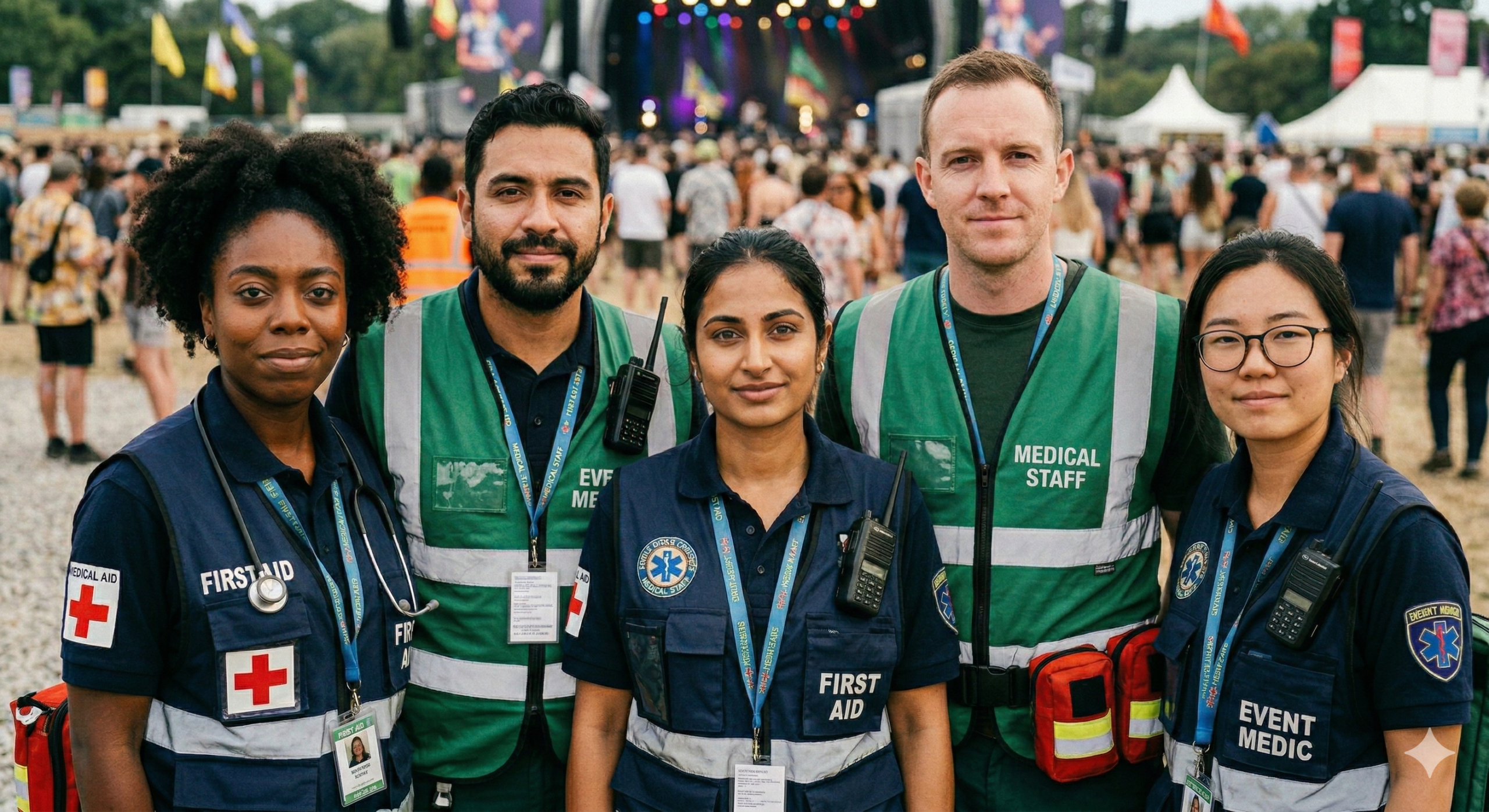
For event production companies, national brands, sports organizations, and touring entertainment productions, events don’t happen in one city — they happen everywhere. And managing a different First Aid provider in each market creates real problems: inconsistent quality, uneven documentation, varying service levels, and a significant administrative headache for your internal team.
National event First Aid staffing is the solution — and it’s a competitive advantage that savvy event producers are increasingly prioritizing. This article explains why consistency in First Aid coverage matters, what to look for in a national provider, and how the right partner can simplify your operations.
1. The Problem with Local-Only First Aid Vendors
Many event First Aid providers operate in a single city or region. While local providers can be excellent, relying on different vendors in each market creates structural challenges that are difficult to manage at scale.
Credential and vetting standards vary from vendor to vendor. Documentation formats and incident reporting differ across markets. There is no centralized visibility into incident trends across your event portfolio. Repeated vendor onboarding consumes time that your team doesn’t have. And there is no continuity of relationship — each vendor starts fresh with no understanding of your events, your standards, or your expectations.
When First Aid coverage varies from market to market, so does your risk exposure.
2. What National Event First Aid Staffing Looks Like
A national event First Aid staffing provider delivers consistent credential verification and background screening standards across all markets, unified physician-directed guidelines under a single Physician Medical Director, standardized documentation and incident reporting across all events, a single point of contact managing all your engagements, and scalable staffing that adjusts to event size and activity profile in any market.
This means your on-site team in Dallas operates to the same standard as your team in Chicago, Boston, or Los Angeles — every time.
3. The Role of a Unified Physician Medical Director
One of the most important benefits of a national event First Aid staffing provider is continuity of physician oversight. When all of your events are covered by personnel operating under the same Physician Medical Director and the same physician-directed guidelines, you get uniform standards for escalation decisions, consistent documentation practices across your portfolio, and a single physician-directed framework that your organization can reference and review.
This is significantly more robust than working with a different local physician — or no physician direction at all — in each market.
4. Simplified Administration for Event Production Teams
For internal event teams, the administrative benefits of a national provider are substantial. One contract, one vendor relationship, and one billing format eliminate the overhead of managing multiple vendors. A dedicated event coordinator manages logistics across all your events. Standardized pre-event planning documentation reduces preparation time. And post-event reports arrive in a consistent format that your team can actually use.
This reduces administrative overhead, eliminates repeated vendor vetting, and gives your team consistent expectations regardless of which city your next event is in.
5. Scalable Coverage for Any Event Size
National event First Aid staffing shouldn’t mean a one-size-fits-all approach. The best providers scale their staffing based on event size, activity profile, and location — deploying exactly the right number of personnel for a 200-person private gathering and an entirely different configuration for a 10,000-person festival, all within the same quality and physician-directed framework.
6. What to Look for in a National Provider
When evaluating a national event First Aid staffing provider, look for:
- Standardized credential verification across all personnel in all markets
- A single Physician Medical Director with consistent guidelines applied everywhere
- A track record with events similar in type and scale to yours
- A dedicated account team rather than a call center
- Transparent documentation and reporting processes
7. National Reach with a Personal Touch
One legitimate concern with national vendors is the loss of personalized service. The best national event First Aid staffing partners combine geographic reach with relationship-based service delivery — meaning you have a specific person who knows your events, understands your quality standards, and is personally accountable to your experience. Scale and attention to detail are not mutually exclusive.
8. Conclusion
National event First Aid staffing gives you one partner, one standard, and one less thing to worry about — no matter where your events take you. For touring productions, national brands, and multi-city event series, it’s not just a convenience — it’s a smarter, more defensible approach to managing risk across your entire portfolio.
Heed Health provides physician-directed event first aid staffing across more than 25 states, with a consistent physician-directed framework, standardized documentation, and a dedicated event coordinator for every engagement. One partner for all your events, wherever they happen.
Contact Heed Health to discuss national first aid coverage for your event portfolio.